|

ドイツのSENSOLYTICS社の走査型電気化学顕微鏡(Scanning
electro-chemical microscopy, SECM)は)を紹介します。
Scanning
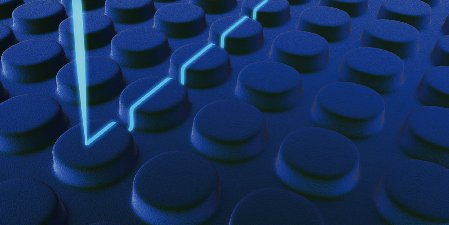
probe microscopies and the idea of SECM
Scanning electrochemical microscopy (SECM) belongs to the family of
scanning probe microscopies (SPM). Aim of these analytical techniques
is to measure and visualize properties of surfaces. To achieve this
goal, a sharp tip is scanned over a surface, while interactions between
this tip and the surface are recorded. Depending on the nature of the
tip, a broad variety of interactions and surface properties can be measured.
The probably most famous scanning probe technique is the scanning tunneling
microscopy (STM), that gives insight into a samples electronic properties.
Another widely used member of the family of SPM is the atomic force
microscopy (AFM), probing force interactions between tip and sample
and eventually imaging surface morphology. The resolution of SPM techniques
is limited by the size of the very end of the tip and can reach an atomic
level in some of these techniques. To be able to probe interactions
between tip and sample surface, the tip has to be within the nearfield
regime. The range of the nearfield into space or bulk volume (if measuring
in liquid media) depends on the technique, since it is determined by
the type of interaction measured.
Different
modes exist to probe the electrochemical activity of a sample surface
by SECM. Of course, all of them operate in liquid environment.
Generator/Collector
mode
The most easy mode in SECM imaging is the generator / collector mode.
An electroactive species is produced or present at one site of the electrochemical
cell and collected at the microelectrode forming the SECM tip. When
the microelectrode is scanned over the active site, an increase in current
can be probed at the microelectrode due to an electrochemical process
(oxidation or reduction) occurring at the microelectrode.
Feedback mode
A second mode used for SECM imaging is the feedback mode. In this mode,
no species of the surface are collected by the SECM tip but an electrochemical
reaction at the tip is modulated by the surface properties. In feedback
mode, an electrochemically active species has to be present in the measuring
solution and the microelectrode forming the SECM tip has to be poised
to a potential driving the convertion of the redox species present.
If the microelectrode
is now approaching an insulating surface, the diffusion of redox species
towards the active area of the microelectrode will be blocked by the
surface. In other words, the hemispherical diffusion field established
at the microelectrode will be "cut" by the (non-conductive!)
surface. The blockage of diffusion towards the microelectrode will lead
to a depletion of species available for the conversion and hence the
current measured at the microelectrode will drop. This effect is called
negative feedback and is observed approaching a insulating surface.
The distance from the surface when the current starts to drop down is
called the nearfield. The nearfield distance is typically 3-5 times
the diameter of the active area of the microelectrode (30-50 μm for
a 10 μm microelectrode).
The other effect
used in feedback mode is the positive feedback. It is observed
when the microelectrode is approaching a conductive surface. Following
the Nernst equation, a conductive surface will establish a potential
that will be able to drive the opposite reaction to the conversion happening
at the microelectrode. If an oxidation process occurs at the microelectrode,
the conductive surface's potential will re-reduce the species and hence
induce a redox cycling leading to an increase in current at the microelectrode.
In other words, the equilibrium that is disturbed by the SECM tip (microelectrode)
will be reestablished by the Nernst potential of the surface to re-convert
the species converted at the tip and will therefore increase the current
at the tip since no depletion of convertible species happens.
The visualization
of the electrochemical activity of surfaces using SECM in feedback mode
takes advantage of a change in feedback signal, i.e. positive feedback
over conductive/electrochemically active areas vs. negative feedback
over insulating/non-conductive/electrochemically inactive areas of the
surface. Different electrochemical activities will also be distinguished
by different amounts of positive or negative feedback.
|
基本のSECM構成:
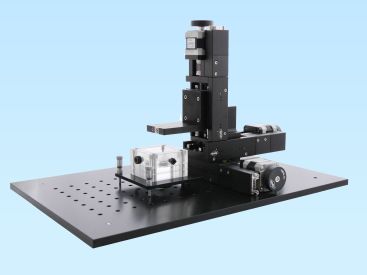
基本のSECM構成はバイポテンショスタットと、XYZ - steppermotor positioning systemです。25x25x25
mmスキャン範囲、 30nm分解能
Sensolytics
Base-SECM
The starting point for all SECM experiments: a complete scanning
electrochemical microscope, including : a high-quality steppermotor-controlled
xyz-positioning system : 25x25x25 mm range at 1/32 μm resolution
a powerful PalmSens bipotentiostat offering all the EC-techniques
you need
full system control via an industrial PC (peripherals not include
|
|
|
オプションHigh-Res:
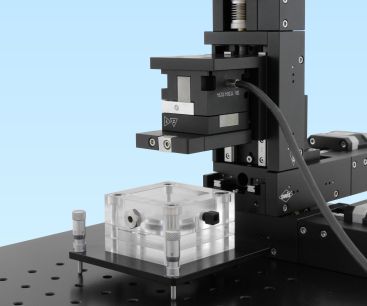
分解能向上するため、piezoelectric positioning systemより 100x100x100 μmスキャン範囲、3nm分解能
Option ´High-Res´
To increase the imaging quality of the Sensolytics Base-SECM,
the option 'High-Res' provides a piezoelectric positioning system.
It offers a 3 nm resolution with a scan range of 100x100x100 μm
and allows to include a three-point tilt compensation mechanism
|
|
Option 'AC'
To satisfy the growing interest in corrosion science, the option 'AC'
is equipped to perform alternating current measurements with your Sensolytics
SECM.
オプションShear-Force:
Sophisticated feedback mechanismよりチップとサンプルは一定の距離を保ち、スキャンする機能です。
Option ´Shear-Force´
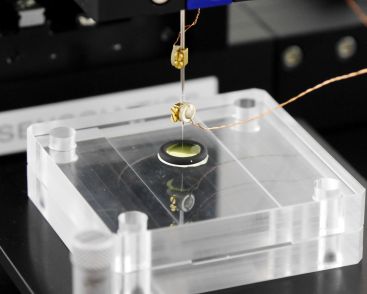
To precisely separate topographic and electrochemical information, the
option 'Shearforce' provides the ability to control the tip-to-sample
separation. The tip is held in a constant distance of 50 to 300 nm above
the sample surface by means of a sophisticated feedback mechanism.
参考文献
インターケミ株式会社
〒270-0013千葉県松戸市小金きよしヶ丘3-7-7
TEL:
047-344-8558 FAX: 047-344-8108
e-mail: sales@autolabj.com
|